Multilingual SEO: Complete Guide to Rank Websites Globally
Table of Contents
The time to grow your company internationally has come, rather than if you wish to do so. Online shopping, browsing, and searching are now possible in multiple languages. The loss of organic traffic and new customers is substantial if your site is only optimized for one language. You may avoid this with the help of multilingual SEO.
DecodeUp's international SEO professionals can help your business build and improve a website that people can see in different languages and areas. This detailed guide will teach you everything you need to know about international SEO, beginning with what it is, why it's important, and how to use it to achieve long-term growth for your business.
What Is Multilingual SEO?
Multilingual SEO is the process of improving a website in such a way that it is able to get better ranks in search results for different languages. It is not just one language version of your website, whereas bilingual SEO makes sure that every language version is well-organized, checked, and optimized.
Multilingual SEO includes:
Language-specific keyword research
Proper URL structure
Localized content (not just translated)
Correct use of hreflang tags
Optimized metadata for each language
A strong technical SEO foundation
Whereas conventional SEO works with one language, multilingual SEO is primarily about knowing that search behavior varies from one language to another and also working out how search engines detect and present material in various languages.
Why Multilingual SEO Is Important for Global Growth
Expanded Reach and Market Share: The first thing that comes to mind is the ability to engage with a much wider audience. Approximately 25% of all online users are native English speakers. When you work in many languages, you have access to a large global market that is currently underutilized. As a result, a virtual chain of events occurs: first, the brand becomes more exposed, which increases traffic, and last, the number of conversions Increases.
Improved User Experience: Content displayed in the user's native language encourages them to interact with it. It boosts confidence, simplifies comprehension, and makes the user feel more at ease and familiar. If users feel understood, they are more likely to utilize the site, seek your products, and buy from you.
Higher Conversion Rates: One of the benefits of improved user experience is an increase in conversion rates. When your advertising messages, product specifications, and call-to-action lines are clearly understood by the user in his language, he is more likely to convert from a visitor into a buyer.
Enhanced Brand Authority and Trust: Companies that invest in content in multiple languages appear to care about their global audience. Such a move improves the brand's authority and fosters trust. It demonstrates that you value your global clients and are willing to make an extra effort to suit their needs.
Competitive Advantage: Although multilingual SEO is getting increasingly popular, many companies are overlooking it. As a result, you have a huge opportunity to differentiate yourself in international marketplaces. By implementing this plan from the start, you will be able to gain market share before your competitors.
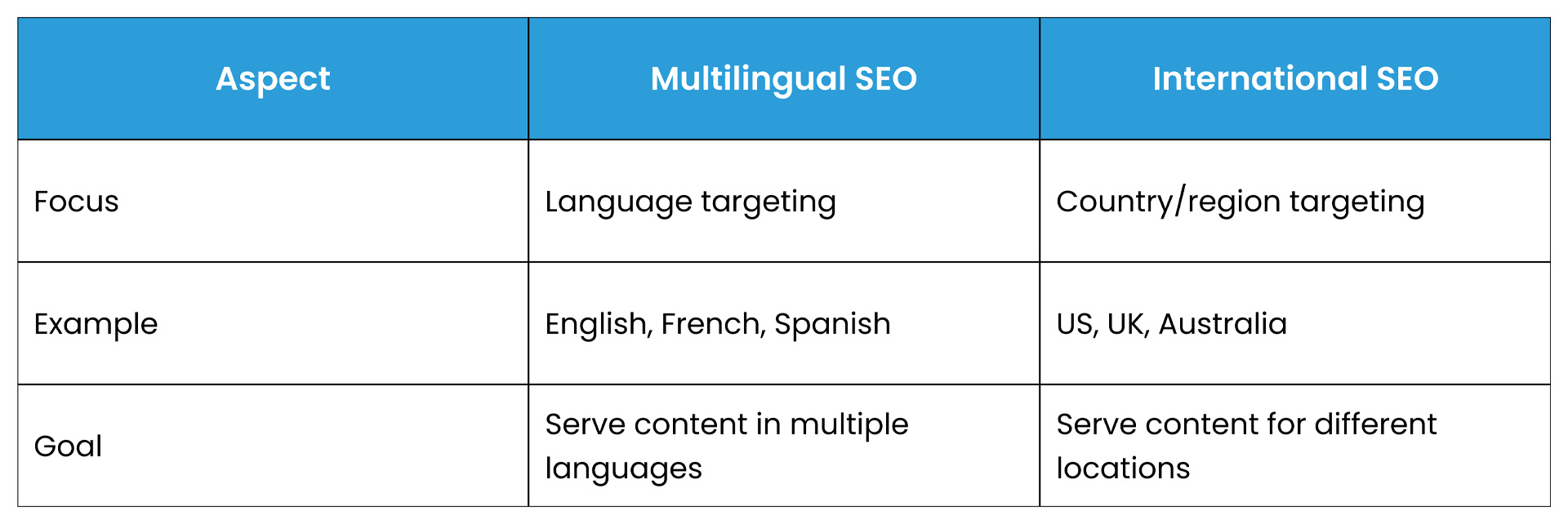
1. Multilingual SEO vs International SEO
Although often confused, these are not the same.
Many websites need both strategies to succeed globally.
2. Step-by-Step Multilingual SEO Strategy
Once the technical foundation is established, the actual process of content development begins. This is the moment at which the bulk of multilingual SEO efforts either succeed or fail.
Beyond Direct Translation: Direct translation is usually insufficient. Localization is more than just changing words; it involves tailoring the content to the cultural, social, and linguistic characteristics of the intended audience.
Cultural Sensitivity: A concept that is liked by one culture can be disliked by another. So, it is better to know the customs, the jokes, and the sensitive things of the locals.
Currency and Units: It is better to use local currencies, measurement units (e.g., metric vs. imperial), and date formats.
Imagery: Ensure that the visuals are culturally appropriate and useful for the target audience.
Calls to Action: Make the CTAs relevant to the locals and use common words.
Legal and Regulatory Information: Update the legal notices, privacy policies, and terms of service to conform to local legislation.
Keyword Research in Each Language: Content localization is largely dependent on this step. Just translating your English keywords is not going to give you a good result. For every language you want to target, you have to do proper keyword research.
Native Speakers/Local Experts: Work with native speakers or local SEO specialists who are not only skilled in the language but also understand how to do searches in it.
Local Search Trends: Find out which words, phrases, and questions people commonly use when searching in a specific language and region.
Tools: Use multilingual keyword research tools like Ahrefs, Semrush, or Google Keyword Planner, and apply language and country filters.
Long-Tail Keywords: Always remember that long-tail keywords can bring you the most targeted traffic.
High-Quality, Engaging Content: High-quality, useful, and interesting material is essential, regardless of the language used. It should solve issues, answer questions, and add value to its target audience.
Original Content: While it is fine to adapt existing content, if it makes strategic sense, consider developing new content tailored to the multiple language markets.
Proofreading: Native speakers should constantly evaluate the content to ensure that there are no grammatical errors, inappropriate phrasing, or cultural misunderstandings.
Maintain Consistency: Your brand voice and messaging should be consistent across all language versions, even after localization.
3. Select the Best URL Structure
There are three main URL structures used in multilingual SEO:
a. Subdirectories (Recommended)
decodeup.com/en/
decodeup.com/fr/
decodeup.com/es/
✔ Easy to manage ✔ Shares domain authority ✔ Best for most businesses
b. Subdomains
fr.decodeup.com
es.decodeup.com
✔ Clear separation ✘ Requires more SEO effort
c. Country-Specific Domains
decodeup.fr
decodeup.es
✔ Strong local signal ✘ High cost and maintenance
At DecodeUp, we usually recommend subdirectories for scalable multilingual SEO.
4. Translate and Localize Content Properly
Translation alone is not sufficient. Localisation refers to:
Tone and wording
Examples and references
Measurements, currencies, and formats
Cultural expectations
Don't use automatic translation tools for the content that is to be published. A professional or native, level localization makes the site more trustworthy and improves the rankings.
5. Implement Hreflang Tags Correctly
Hreflang tags notify search engines about which language version should be displayed to visitors.
The most common error in a multilingual SEO plan is incorrect hreflang configuration.
6. Optimize Metadata for Each Language
Language versions should be:
Unique title tags
Meta descriptions that are localized
Alt text for the translated image
Local schema markup.
You should not be able to utilize English metadata in all languages.
7. Internal Linking for Multilingual Websites
Internal links provide information to search engines about the structure of a website.
Best practices:
Link different language versions in a clear way
Use the localized anchor text
Don't allow cross-language confusion
Ensure that language switchers are easily accessible and usable by
8. Build Local Backlinks
Backlinks from other websites indicate a high level of trust and authority for your site.
Examples:
Local blogs
Regional Business Directories
Country-specific publications
Local backlinks are a powerful strategy for considerably improving multilingual SEO performance.
9. Technical SEO for Multilingual Sites
Technical SEO is the foundation for everything that follows.
Make sure you have:
Quick loading speeds everywhere
Responsive design
Navigation is free of any unnecessary components
Correct canonical tags
Secure HTTPS
Technical errors may prevent multilingual pages from ranking properly.
Multilingual SEO Best Practices
Separate URLs for each language
Local keyword research, using canonicals
Human translations are reviewed by humans
Text, photos, and videos are perfectly optimized
Internal connecting patterns are unaffected
Following these best practices ensures long-term SEO success.
Common Multilingual SEO Mistakes to Avoid
Using only IP-based automatic redirection
Using multiple languages on a single page
Ignoring the metadata translation
Incorrect use of hreflang
Ignoring the purpose of local searches
By steering clear of these errors, you can keep your rankings from dropping for months.
How to Measure Multilingual SEO Success
The correct multilingual SEO strategy is definitely not a "set it and forget it" kind of job. It requires constant checking and evaluation in order to have a clear picture of which activities bring results, which ones are unsuccessful, and where there is a possibility of further enhancement.
Google Analytics (or a comparable program): Use different Google Analytics views or filters for every language to monitor:
Traffic Sources: From where is the multilingual traffic reaching you?
User Behavior: What is the manner in which people interact with your content in various languages (bounce rate, duration on page, pages per session)?
Conversion Rates: How effectively is your translated landing page attracting visitors to take a desired action?
Google Search Console: Use Google Search Console for checking the performance of each language version. Find out the keyword rankings, indexing issues, and hreflang errors.
Rank Tracking: Use rank tracking tools to keep track of your keyword positions in different languages and regions.
User Comments: Get feedback from your users worldwide. Do they consider the content to be of high quality? Is there anything that is not covered or unclear?
Future of Multilingual SEO
Future multilingual SEO tactics are probably going to focus on:
AI and assisted language comprehension
Accuracy of user intent
Rankings based on experience
Excellent localized content
Search engines continue to reward websites that genuinely provide value in the user's language as they develop.
Why Choose DecodeUp for Multilingual SEO?
At DecodeUp (https://decodeup.com/), we specialize in:
A multilingual approach to SEO
Localization of websites
Technical application of SEO
Optimization of content
Visibility in global searches
We help businesses scale internationally by implementing effective SEO tactics. Connect with us to implement effective SEO strategies.
The last line
Multilingual SEO is an effective business growth tool for companies seeking global expansion. It is far beyond basic translation; it requires meticulous planning, technical accuracy, and content optimization for local customers.
Using the many language SEO strategies covered in this guidebook, your website will be able to:
Rank in multiple languages.
Increase worldwide organic traffic.
Increase engagement and conversions.
Establish a worldwide authority on sustainable nature.
If you want to do multilingual SEO properly, DecodeUp can help you expand your worldwide reach.
CEO & Founder of DecodeUp, a tech agency helping brands scale in eCommerce and Fintech. With 12+ years of experience, he blends technical expertise with business insight to build user-focused platforms that drive growth, engagement, and lasting impact.
A private limited company incorporated in India under company number U72900GJ2019PTC111721. Registered at 207-B, Trinity Business Park, L. P. Savani Road, Surat, Gujarat 395009