Almost 61% of consumers abandon a business as a result of negative customer experiences, making Customer Experience Design an essential component of a company's success. Customers nowadays want more than just high-quality items and low pricing. They seek simple, consistent, and valuable interactions at every point of contact, from the initial visit to ongoing support.
Customer Experience Design is all about giving every connection a purpose, allowing businesses to move beyond transactional interactions and connect emotionally with their customers. Customers are more likely to become loyal when they feel valued and understood. Companies that use suitable Customer Experience Design methods have the opportunity to increase customer engagement, strengthen customer connections, and create customer experiences that lead to customer retention.
What is Customer Experience Design?
Customer experience design, or CX design, is an intentional method of determining how each connection a customer has with your business will result in pleasant, memorable, and consistent experiences. It includes all interactions, from the first advertisement buyers see to the support provided after the purchase, and beyond. CX design differs from traditional marketing or product development in that it considers the entire journey, ensuring that each stage aligns with the needs, expectations, and even opinions of the consumers.
Essentially, customer experience design is a system based on facts and focused on the customer. It collects data from surveys, analytics, and feedback to better understand consumer suffering and identify new opportunities. Consider 2025, the year when AI-powered technologies will increase; firms will be able to analyze huge volumes of data in real time to create client experiences. The goal here is not to have a single conversation, but to develop a story that keeps the customer feeling valued and understood.
Consider how the design of the customer experience has changed. Twenty years ago, it was primarily about customer service calls. Today, it includes digital ecosystems such as applications, social media, chatbots, and virtual reality. What is the objective? To create emotional connections that turn one-time customers into loyal brand champions.
According to the 2025 Global Customer Experience Index, 21% of organizations' scores have declined, highlighting the importance of a well-thought-out customer experience plan.
Key elements of Customer Experience design include:
Empathy Mapping: Understanding the emotions of customers at every level.
Touchpoint Optimization: Helping customers to make a change from one channel to another in a way that is easy and comfortable for them.
Feedback Loops: Continuously modifying the product or service based on the input of actual users.
Personalization: Developing consumer segments to serve them better by utilizing data like browsing history or favorite items.
Basically, CX design is about converting interactions to relationships, which is the basis for long-term business success.
The Business Impact: More Than Just Feel-Good Factor
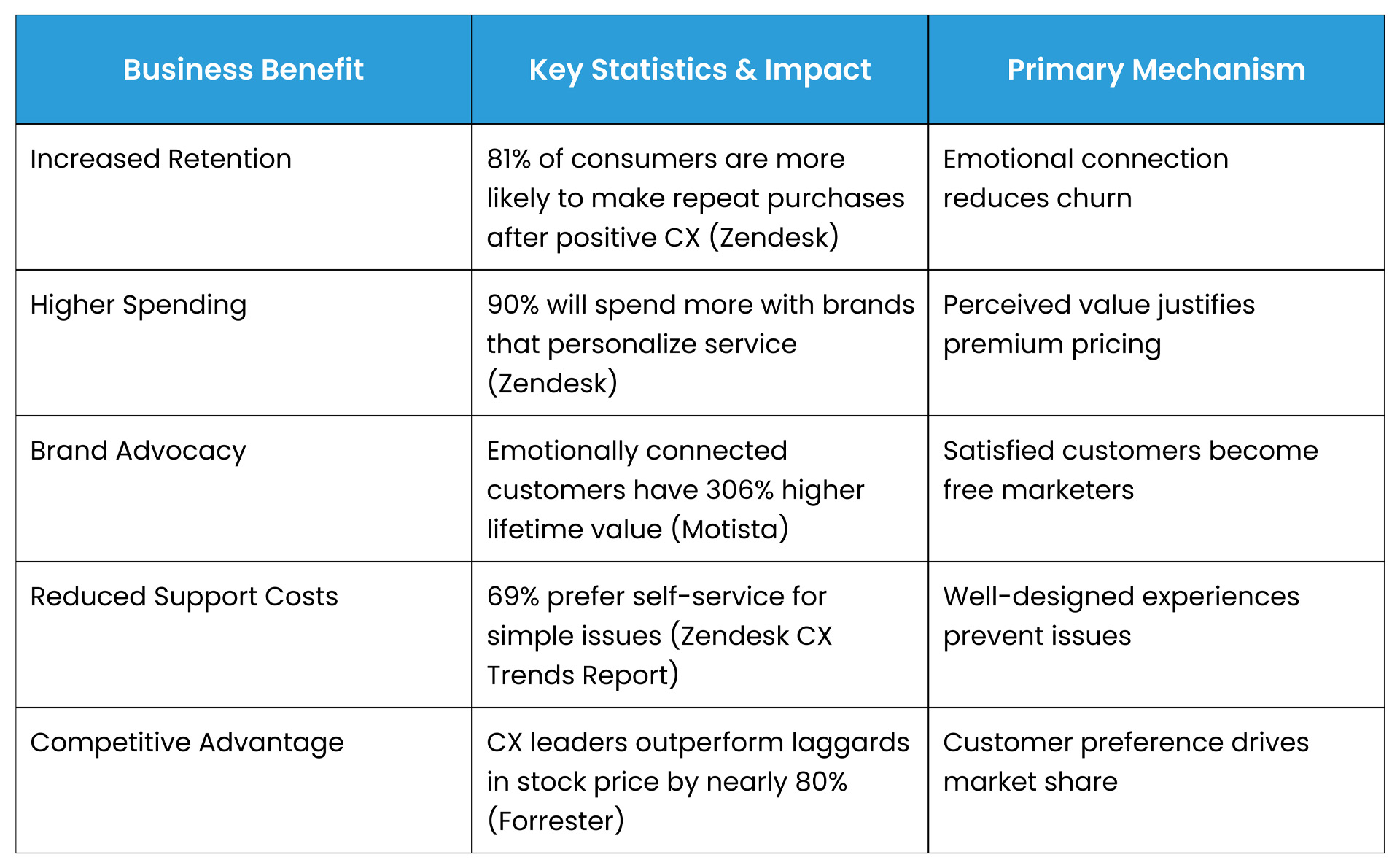
Investing in Customer Experience design offers measurable business outcomes that directly impact your bottom line:
Table 1: Concrete Business Benefits from Excellent CX Design.
Customer Experience Design vs. UX Design: Key Differences
Customer experience design and user experience (UX) design are different things that have been confused. These are two different fields that have a lot in common and are closely related. It is necessary to know the differences when deciding to put the strategies into action.
UX design is basically the work of making sure the product is easy and functional for people to use. For example, a good UX could mean testing different positions of a "buy" button on a checkout page to find the one that results in fewer abandoned carts. It is also true that 74% of users are more likely to return to websites with good mobile UX.
On the other side, CX design moves beyond a single brand to include the whole brand ecosystem. It includes elements before and after the interaction, for instance, marketing emails, customer service chats, and even packaging. CX deals with the emotional side of the experience, i.e., how the customer feels about the brand as a whole. Although UX is a part of CX, the latter integrates different departments, e.g., sales, support, to deliver consistency.
For example, a customer may have a wonderful UX on your eCommerce site, but if the follow-up support is bad, then the overall CX will be negative. On the other hand, excellent CX can forgive slight UX deficiencies by attracting trust and loyalty.
Key differences:
Scope: UX is product-specific; CX is brand-wide.
Focus: UX emphasizes functionality; CX prioritizes emotions and relationships.
Team Involvement: UX often involves designers and developers; CX requires cross-functional collaboration.
In 2025, with 70% of organizations planning to hire UX professionals, integrating UX into broader CX frameworks will be important. Businesses that blur these borders risk isolated efforts, while those that harmonize them earn advantages in customer retention.
Benefits of Customer Experience Design
Investing in CX design results in various benefits that go beyond the immediate revenue. With a statistic showing that 61% of consumers change brands after only one bad experience, improving CX is necessary not only for staying in business but also for expanding.
To start with, CX design helps to retain customers. One, to, one experiences enable customers to feel that they are recognized, which is why they keep coming back. Research shows that 81% of customers are more willing to buy again after they receive positive service, and 90% of them will spend more if they get personalized interactions. When brands take the route of killing their customers' pain points before they even arise, they lower the rate of employee turnover and increase lifetime value.
Secondly, it helps the company to coordinate different departments within the company. Customer experience design produces common maps that clearly explain the work of each department through the customer journey. This helps to make the company work more smoothly, decreases the number of mistakes, and encourages the customer, first to approach the company culture. Most probably, the support teams will get quicker solutions and higher efficiency as a result of this.
Another way to show how customer experience design affects brand reputation is to state that satisfied customers will be the primary consumers of brand promotion through word of mouth to friends, which will then be shared via social media. With real-time engagement, which is a trend in 2026, delighted customers become natural evangelists for the company, resulting in decreased acquisition costs.
Furthermore, customer experience (CX) design helps to achieve competitive differentiation. Excellent experiences draw attention in saturated markets, thereby identifying a brand. For example, in the context of eCommerce, it may indicate excellent omnichannel assistance, allowing users to seamlessly go from an app to a chat without having to repeat information.
Economically, the gains are incredible. Companies increasing CX report revenue growth in 84% of cases, loyalty spikes in 95%, and cost reductions in 79%. Moreover, generative AI investments, prioritized by 45% for customer experience upgrades, promise even improved efficiencies.
Other benefits include:
Data-Driven Insights: CX uncovers trends for product innovation.
Risk Mitigation: Proactive designs avert catastrophes like incorrect reviews.
Employee Satisfaction: Empowered teams enjoy higher outcomes.
In summation, CX design isn't an expense; it's an investment with proven ROI.
Customer Experience Design Examples
We may step down the concept of customer experience design through the evaluation of actual, real-world examples from different industries. These examples highlight how firms make advantage of customer experience to achieve loyalty and expansion.
Bang Energy Building Trust Through Ambassadors: Establishing Confidence with the Help of Ambassadors: Bang Energy focuses on Gen Z through a real brand ambassador program. Partnering with people who live their active lifestyle, they made the marketing more personal and gained greater trust. As a result, the company generated a $1.2 billion turnover from June 2020 to June 2021. By 2025, comparable strategies will employ AI to connect influencers with audience segments.
Robinhood Transparency in Fintech: One of the most transparent communication aspects of Robinhood fintech was the referral program before the actual launch. It made people talk simply because it was one of the most transparent ways to get on a waiting list. Every user received news and a very simple way of getting started, thereby trust was built. As a result of this, several close to one million sign-ups were recorded. Currently, along with their CX, they provide real-time chat support and a range of educational resources that are in line with the simplicity that investing users demand.
Noom Relatable Influencer Marketing: Noom, the weight loss app, has been using different influencers to promote the integration, where the influencer features work more profitably. This strategy brought 3, 000% in revenue in four years. Their client experience is also extended to the personal trainers and software features, which are responsive to the user's achievements.
Sunspel: Subtle Delights in Packaging. A t-shirt brand from Sunspel adds a simple postcard with shipments, thus generating good feelings after the product opening. This cheap-to-implement tactic encourages loyalty by giving consumers the feeling that they are valued, thereby showing how small things can make a big difference in the overall Customer Experience Design.
Consistency and Technology: Noom's weight loss application uses various influencers to communicate a message of inclusion, thus providing more affiliate features. This way, the company's turnover has increased by 3000% in 4 years. Their customer experience goes beyond to include personalized coaching and software functionalities that are sensitive to the user's achievements.
Real-Time Engagement: One of the simplest ways Zappos, a company that is very well known for its excellent delivery of service, uses to flaunt its greatness is by providing its customers with a chat option that is always open and even offers surprise upgrades. The company's CX strategy gives the staff the liberty to commit to the extra work; thus, it is one of the reasons why they achieve a high score of NPS.
Gamification: Duolingo turns language learning into a game through the use of streaks, badges, and leaderboards, thus making the learning process fun and attractive. This CX creation keeps the users as a continuous source of motivation, with the majority of them accessing their accounts every day.
These examples show that great CX design blends empathy, technology, and creativity to meet growing customer expectations.
The Customer Experience Design Process
Designing an effective CX strategy involves working through a well-defined series of steps. This is the step, by, step guide for 2025 that will help you do it.
Collect Customer Data: To begin with, start off with surveys, analytics evaluation, and social listening. Customer relationship management systems (CRMs) are effective tools for collecting data obtained from interactions, emails, and activities.
Develop Personas: Generate imaginary characters that reflect real scenarios, obtaining your ideas from demographic data, the behaviors, and the challenges of the consumers. A character "Busy Parent" as an example may be the one to find the fastest mobile checkout option most beneficial.
Map the Customer Journey: Identify different stages very clearly, starting from awareness and going all the way to advocacy. Find the instances where customer experience is deteriorated, for example, by delayed loading times, and also where the consumer can be wonderfully delighted.
Design Touchpoints: Make every interaction as efficient as feasible. Use AI to customize the experience; therefore, multiple channels can have the same amount of interaction.
Implement and Test: Bring the changes and A/B test. Make a record of the meters that stand for the customer's state of mind, including satisfaction scores.
Iterate Based on Feedback: Establish continuous improvement processes. Keep up with the trends like hyper, hyper, customization, and change accordingly.
Such a procedure guarantees that CX design is iterative and responsive.
Tips for Building Your Customer Experience Design Strategy
These are practical ways to raise your CX in 2025.
Build Cohesive Touchpoints: Use omnichannel channels to provide customer experiences that are the same across all channels. Combine customer data sources to get a complete view.
Share Journey Maps: The teams use it to coordinate the work. The ongoing workshops are the main strategy for cooperation.
Implement Knowledge Bases: Support for users (69% choose this) is the most developed internationals; agent productivity is the most developed domestically.
Be Adaptable: Empathy is a skill that you can train and keep an eye on AI chatbots as a trend.
Leverage AI: A large part of UX professionals (71%) think that AI will change the future, so they use it for predictive assistance.
Focus on Emotional Connections: At each level, you can correspond to the mood, for example, when testing the emails for celebration.
Measure and Optimize: Use KPIs like CSAT and churn rates.
These are some of the ways by which your CX can be changed completely if you put them into practice.
Optimizing the Customer Journey with CX Design
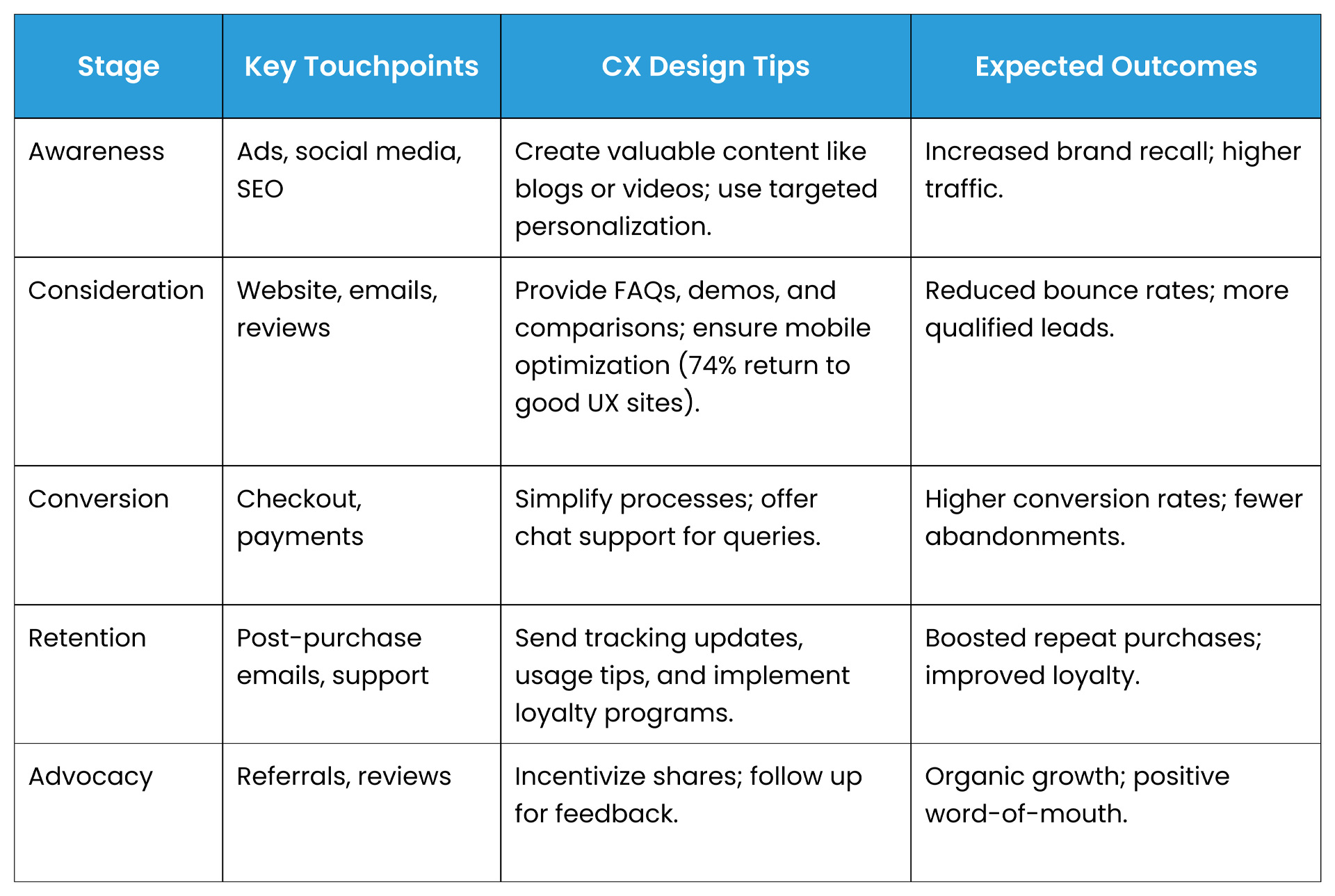
The customer journey is the backbone of CX. Optimize it by addressing each stage.
This table provides an overview for convenience. To further visualize, we suggest making an infographic that depicts the client trip flow.
Marketers are able to build seamless experiences by optimizing these steps.
Tools and Platforms for Customer Experience Design
Some of the solutions, Zendesk, Shopify, and a lot of AI systems, will make CX easy in 2025. CRM is the place where data is stored, while analytics tools are the ones that track the journeys. If you want to design, then choose Figma for your prototypes. There are also some futuristic tech innovations, such as AI-powered sentiment analysis, which is a method of making the designs more predictive.
Customer Experience Design Future Trends
The next decade's customer experience design will revolve around smart AI, hyper-personalization powered by AI, customer support that can pre, empt needs, and sustainability initiatives being the ones that stand out most. As 97% of companies have already made up their mind to invest in Gen AI, it is quite logical to expect more clever chatbots and the use of predictive analytics. The topics of gamification and omnichannel will not disappear but rather transition towards a greater concentration on human-centered AI.
The Final Sum-up
Customer Experience Design is a powerful tool that may help your organization succeed by ensuring that every interaction is simple and enjoyable. Essentially, it focuses on the emotional part of the customer's contact with the website, product purchase, or service request. Customers are more likely to trust your brand if these interactions are acknowledged as convenient and user-friendly.
Customer Experience Design is a comprehensive view of the customer journey. So it's the first visit, the purchasing procedure, and the after-sales service. Customers are happy when every stage is completed effectively, as they feel prioritized and understood.
Excellent Customer Experience Design focuses on giving clients the most attention possible at all stages. As a result, it converts one-time purchases into recurring customers.
A firm that is founded on the wants and sentiments of its consumers not only survives difficult times but also grows into a brand that people love, trust, and tell their friends about.
CEO & Founder of DecodeUp, a tech agency helping brands scale in eCommerce and Fintech. With 12+ years of experience, he blends technical expertise with business insight to build user-focused platforms that drive growth, engagement, and lasting impact.
A private limited company incorporated in India under company number U72900GJ2019PTC111721. Registered at 207-B, Trinity Business Park, L. P. Savani Road, Surat, Gujarat 395009