
Website Design and Development services are the procedures by which organizations create and manage websites that not only look attractive but are also functional and easy for visitors to browse. Such services include a broad spectrum of activities that range from the development of layouts, writing the code, managing the content, SEO optimization, to the hard and soft routines of maintenance that are required for the site to be efficient on any device.
Professional website design and development services help businesses establish a strong digital presence by combining a visually appealing design with advanced technology. These services are carefully designed to connect with the clients' specific goals and attract the intended audiences efficiently. Custom web applications and responsive design provide optimal accessibility, functionality, and user experience across several platforms.
Many suppliers integrate these services besides graphic designing, branding, content planning, and digital marketing to make the site a comprehensive business growth tool. The selection of the proper service depends on the company’s size, sector, and goals; therefore, it underscores the importance of professional expertise and trustworthiness in both design and technical work.

Website design focuses on the visual layout of a website's various components. This includes selecting colors, fonts, graphics, and a general layout to provide an excellent user experience. The ultimate goal is to create visually appealing and user-friendly websites.
Website design focuses on the visual layout of a website's various components. This includes selecting colors, fonts, graphics, and a general layout to provide an excellent user experience. The ultimate goal is to create visually appealing and user-friendly websites.
Website development is the process of design ideas into working digital platforms. It is a method that requires the use of code in a very planned manner to bring functionalities like content management systems, database architectures, and user-friendly new features that interact with the users on a website. Development is the use of both front-end and back-end skills, most times, together, to get the best performance, stability, and compatibility with different devices.
Together, these design and development services are thus the main enablers, so to speak, of the whole online creation world from a mere concept to the final live website.
Key components of these services are:
Without these components, the website would not work correctly or meet user needs.
Professional website design and development create a visually appealing and efficient site that aligns with business goals. It ensures that consumers can browse easily, that search engines can properly index the material, and that the website will become more user-friendly as the business grows.
A well-designed professional website is easy to use and navigate. Users may discover information quickly thanks to simple navigation and fast page loading. The site's adaptable design makes it easily accessible on various platforms, including smartphones and tablets.
Expert web development solutions typically include top SEO strategies to increase website visibility and rank higher in search results. This is done by having a structurally accurate page layout, exact use of meta tags and keywords, and thorough technological optimization for quick loading times, and following the rules of the search engines to attract and interest the target users.
Professional growth includes studying and following SEO best practices, which improve a website's exposure in search engine rankings. To reach the intended audience, optimal page architectures, meta tags, and keyword integrations are used. Developers also ensure that websites load quickly and adhere to search engine-friendly technological standards.
A mobile-friendly design improves ranks as search engines prioritize mobile usability. The use of analytics software enables businesses to monitor the traffic to their website and make relevant modifications to their plans. Regularly updating and securing websites improves their image and prevents a decline in search results.
A website that is scalable and created by experts.Properly designed web platforms should be able to support expanding business needs without a complete overhaul. Pages, functionalities, or integrations like eCommerce or booking systems can be simply added to the site. Such adaptability corresponds to a company's expansion strategy, for instance, by targeting new markets or introducing new products.
Security measures are in place to secure client information; thus, trust, which is necessary for repeat business, is built up. Besides, professional interventions cover the website's continual upkeep and its performance enhancement, thereby, the website will be dependable over a long period. In essence, the site turns into a tool for customer acquisition, sales, and deepening customer relationships.
Website design and development services vary significantly in their breadth, capabilities, and technological features. The services range from a fully customized solution designed for a specific brand to a simple template-based option. Services include setting up a dedicated eCommerce platform and developing an adapted website for every device.
A custom website design allows companies to provide a unique digital experience that aligns with their brand's identity and objectives. It actually means designing each aspect from the start while keeping the user experience, appearance, and functionality in mind. Using this strategy, developers are free to create features that directly answer business challenges, allowing them to be equipped with the most modern technology and unique workflows.
Custom design is perfect for businesses that require unique or sophisticated features on their website. Although this method normally requires a longer time and more resources, it provides almost unlimited creative freedom and a scalable structure. This new digital presence aligns perfectly with the brand approach described above.
Template-based design allows a corporation to customize pre-built layouts and structures with its own information, colors, and graphics. In effect, this option reduces development time and costs by leveraging previously developed structures. That is why it is an excellent choice for small firms or startups with limited expenditures.
Furthermore, despite the fact that templates are less customizable than original designs, they can always provide an excellent appearance and responsiveness. There are numerous templates that designers have made simple to use and alter for those with limited technical experience. This solution is ideal for projects with conventional features and a focus on market speed.
eCommerce website creation services enable companies to market their products and services online. These possibilities include integrating a shopping cart, payment gateways, managing a product catalog, and securely processing transactions.
Efficient eCommerce platforms provide integrated services including inventory management, customer account portals, and marketing automation. If a corporation wants to succeed in the digital market, it must prioritize strong security procedures and high-performance architecture. In this manner, the company will be able to operate reliably while also maintaining the trust of its customers. A well-designed eCommerce site can help a company attract clients, streamline sales processes, and enhance earnings in the long run.
Responsive web design ensures a website runs smoothly across multiple devices, including PCs, tablets, and smartphones. Adaptable layouts, images, and CSS media queries seamlessly adjust content based on display dimensions.
As mobile usage grows, this provision becomes increasingly important. Responsive designs not only make the site more user-friendly, but they also reduce the chance of visitors abandoning the page instantly, which improves the website's search engine ranking. This technology ensures consistent interaction across all devices, making it an important component of modern web development strategies.
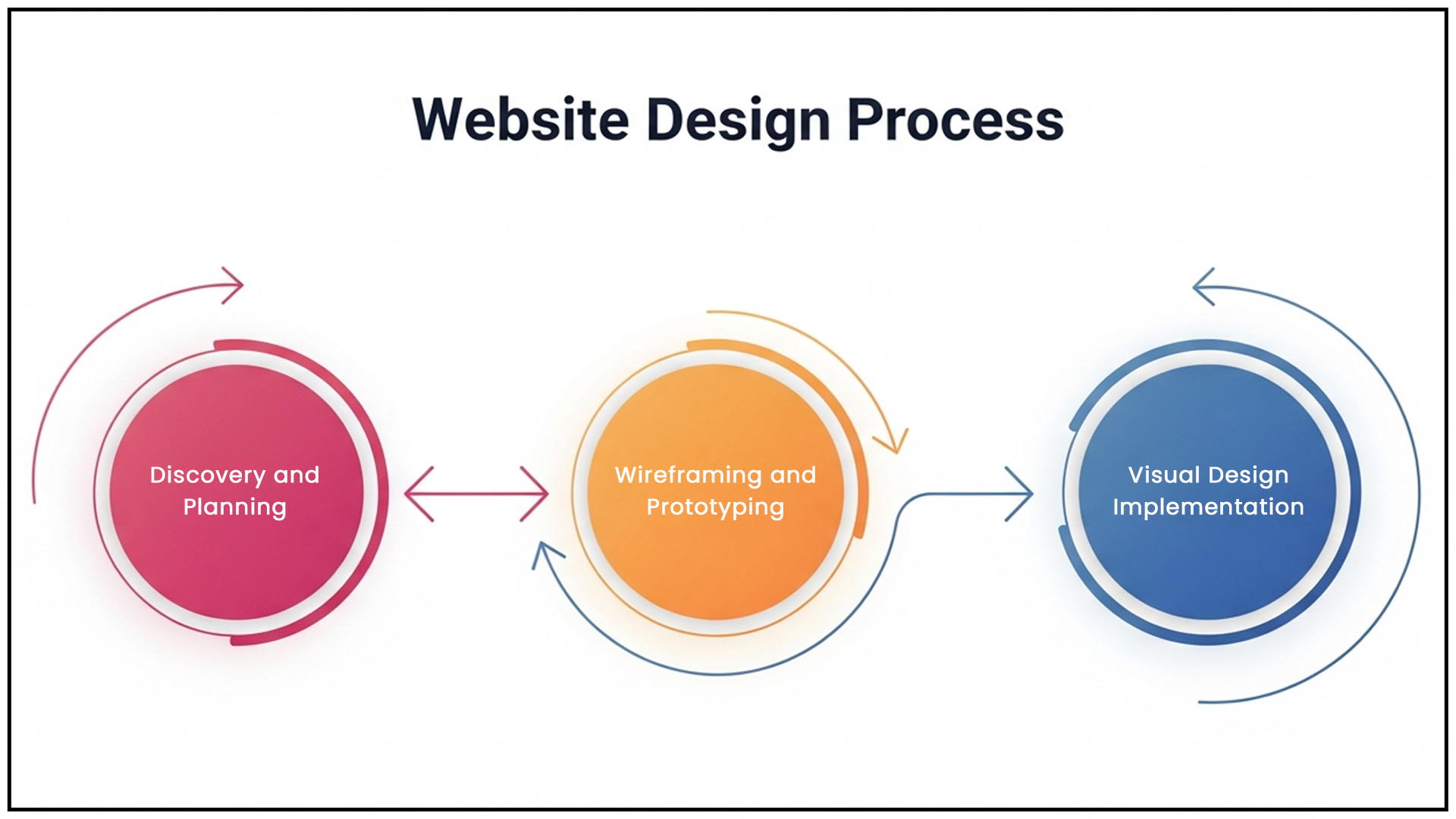
Creating a website is a step-by-step procedure that transforms a notion into a functional and visually appealing online platform. The entire procedure consists of strategic actions, preparation, and innovative work to ensure that it serves both users and the business as effectively as possible.
The first step is to fully understand the client's purpose, audience, and competition. The company defines project goals, milestones, and required resources.
The project's primary outputs include a creative brief, a thorough sitemap, and a well-elaborated content strategy. These early tasks bring the stakeholders' visions into alignment and lay the groundwork for the subsequent design and functional development stages. Before the project begins, stakeholders typically examine and approve these agreements formally.
This rigorous planning work aims to reduce the risks that will arise later in the process by anticipating potential issues. Additionally, it allows for efficient feature ranking based on user needs and corporate objectives.
Wireframing creates a plan for a website's architecture and page layout without graphic design elements. It is a stage that focuses on content localization, navigational routing, and user interaction patterns.
Lo-fi wireframes allow for quick adjustments and the collection of feedback, highlighting portions of the application that are difficult to use and improving the user experience before creating the program code. Dynamic prototypes can simulate the client's view of the site's navigation, allowing them to comprehend the flow of the site.
Prototyping is vital for verifying functionality and gathering feedback from stakeholders. It serves as the link between conceptual and visual design, ensuring that the website functions logically and simply.
The stage is currently to incorporate the site's visual identity, typography, color schemes, and images into the wireframes or prototypes. Designers create realistic mockups that represent the brand, attract users, and maintain usability.
Responsive design is one of the focus points therefore the website will be compatible with different screen sizes and devices. Accessibility standards are being implemented so that the digital experiences can be inclusive of all users.
The design aspects align with the client's branding guidelines and marketing objectives. Designers provide specifications to developers to ensure consistent and high-quality code conversion from graphics.
Building a website is a complex process that requires exact collaboration to ensure a functional and appealing website. In fact, each phase is a translation of design concepts and business objectives into technical components that work together.
Front-end development aims to improve the user experience through simple and visually appealing interactions. Front-end development is the technology used to create the look, layout, and user interaction of web pages. It leverages three basic technologies: HTML, CSS, and JavaScript. Ensure the website is mobile-friendly and accessible to provide a user-friendly experience across all devices and screen sizes.
Some of the key functions include the creation of the navigation menus, the forms, the animations, and the dynamic content displays. Additionally, front-end developers improve loading speeds and user experience by effectively managing assets such as graphics and scripts. Besides, they connect with the designers to maintain the visual integrity and follow the branding requirements.
Checking the compatibility across different browsers and the website's usability are the two most crucial actions in this stage, aimed at providing the same level of performance for every user.
Back-end development is about developing code that supports the front-end and handles server-side logic, databases, and application features that are not visible to users but are important for a website to work. Developers establish APIs, handle data storage, put security measures in place, and manage IT setups.
This process is frequently done with computer languages such as Python, PHP, Ruby, or JavaScript (Node.js), and databases like MySQL, PostgreSQL, or MongoDB. Back-end developers build code that allows the system to authenticate users, handle data, manage content, and link with third-party services.
They are responsible for the proper flow of the site's traffic, ensuring the security of user data, and, if necessary, the site content can be dynamically generated from saved info.
Content integration is the process of collecting and organizing a website's textual, visual, and multimedia content to align with the developed model. This stage ensures that the site's purpose and content are clear and organized, and that users can easily log in.
Content migration is the act of bringing in text, photographs, videos, and interactive elements to a content management system (CMS) or directly to the site layout. Correct formatting, SEO optimization, and style consistency are key features of the usage and ranking improvement process in search engines.
Additionally, this stage involves building content update pipelines to enable later modifications without causing any trouble in the site's operation or appearance.
Choosing a website design and development agency means you have to analyze their past work, their technical ability, and their client communication very seriously. These factors determine the output, the usability, and the time-to-success of the website.
Analyzing an agency's portfolio reveals the scope and quality of its previous work. It is especially crucial to evaluate projects of comparable scale and from your field of expertise. This check shows the company's understanding of your business goals and industry challenges.
Time spent in the field may reveal the agency’s potential to take on challenging projects and remain in compliance with the latest web standards over time. Nevertheless, the quality and the closeness of their works to your matter weigh more than their years.
Check out client testimonials and case studies which highlight the problem-solving abilities of the person and also how they were able to achieve the deadlines effectively. A wide portfolio with good visual design and user-friendly interfaces is a good indication of their expertise.
Technical expertise is one of the areas that can only be addressed by a large number of diverse abilities, such as responsive design, multiple coding languages, understanding of CMS, and SEO best practices. Agencies should be trained in the most modern technologies that are appropriate to your project, for example, HTML5, CSS3, JavaScript frameworks, or a particular platform like Shopify or WordPress.
Check if the company provides comprehensive end-to-end services, including strategic planning, development, and post-launch support. Such a comprehensive approach ensures not only quality but also continuity across the whole product lifecycle.
Aside from that, many critical technological aspects should be scrutinized, such as adopting robust security measures, enhancing site performance, and building a responsive mobile version. To reduce the chance of disappointment, ensure the firm has solid and verified references from clients in your specific field.
Throughout the project, it is very important to have clear and consistent communication. The agency that you decide to work with should react quickly to your queries, give you regular reports, and be willing to receive feedback.
It is also very important to have support after the product release. Good agencies are always there for you with their maintenance services, troubleshooting, and updates, which ensure that the website remains safe and working properly.
Find out from the agency how they treat their clients by inquiring about their project management tools and communication channels. A transparent workflow and a support team that is fully committed to you will greatly lessen the chances of misunderstandings and delays in your project.
Effective websites combine technical precision with a user-friendly design to create perfect experiences. Among the important benefits are the flexibility to work on many devices, good-speed performance, and accessibility, which is an inclusive feature for different users' demands.
Mobile optimization is necessary for a site to be able to perform effectively on smart devices like smartphones and tablets, and this is quite significant since most of the time, mobile traffic is larger than desktop traffic. A responsive design modifies the layouts of a page depending on the size of the screen so that the page is still accessible and usable without the need to scroll horizontally or zoom in.
Responsive UI elements, such as buttons, navigation menus, and forms, should be designed for easy interaction across all screen sizes. Media, such as photographs and videos, must be designed so that they load quickly while maintaining quality, allowing the user to have a nice experience without using too much bandwidth.
Furthermore, mobile optimization plays a significant role in search engine ranking criteria, with mobile-friendly sites receiving preference in their listings. To maintain a low bounce rate and keep mobile users engaged, it's important to optimize viewports and provide quick interactivity.
Fast loading times are very important to keep users and to have a good position in the search results. It is necessary that pages load within 2-3 seconds; otherwise, the visitors will leave due to the waiting time. To achieve this, it is required to optimize images, use browser caching, and reduce to the minimum possible the code, like CSS and JavaScript.
The use of content delivery networks (CDNs) helps to deliver content in different locations, thus reducing the time the server takes to respond. Developers also need to ensure that the most important content is loaded first so that the user feels that the website is fast. Slow sites annoy users and have a bad impact on conversions; thus being performance optimization is a feature that cannot be compromised.
In order to be able to effectively serve users with disabilities, websites have to conform to accessibility standards such as WCAG. Some of the requirements include allowing navigation by keyboard, having suitable color contrast, and giving a descriptive alt text to images.
Moreover, websites that are accessible have inclusive headings, a well-organized structure, and are compatible with screen readers. The use of ARIA landmarks helps the users of assistive tech to have a better experience. Compliance with these standards, in addition to extending the client base, is in line with the law in many parts of the world, thus providing equal access and usability to everyone.
Maintaining a website's functionality, security, and efficiency requires ongoing efforts. It is a combination of upgrading software, monitoring security risks, and enhancing performance to ensure that the site works properly and is safe.
Regular updates also cover the major software, plugins, and content management systems. These updates fix bugs, close security flaws, and introduce new functionality. Failure to update software might cause issues with component functionality and expose the site to safety risks.
A consistent content strategy is key to maintaining a website's relevance. Part of this is adding new pages, changing images, and updating the language to reflect changing goals. Frequent updates keep the site from becoming stale and allow users to remain engaged.
A well-planned implementation system often means that all changes are tested in a staging environment before being made public. This strategy minimizes downtime, reduces errors, and allows for easy maintenance without interrupting the live site.
Security monitoring involves monitoring the site for malware, hacking, and illegal access to user data. Essentially, it involves using a gadget or application that can alert you to unusual activity, such as someone attempting to log in to your account multiple times or your website traffic suddenly increasing.
Regular security audits are an effective technique to identify flaws in plugins, software versions, or server configurations. It is essential to resolve issues immediately to protect data and comply with data protection requirements.
Furthermore, backup processes are part of security monitoring. Regular and automated backups ensure that data is rapidly restored in the event of an attack or failure, minimizing data loss and website downtime.
Performance optimization focuses on making a website faster, more responsive, and user-friendly. It is essentially the process of configuring cache, optimizing images, cleaning databases, and so on in order to speed up the site's loading.
Monitoring server performance and user interaction metrics can help identify problems or slow-loading pages. Fixing these issues can lead to higher search engine results and more visitor retention.
Furthermore, optimization refers to the site's ability to expand efficiently as traffic increases. Load testing and resource allocation modifications can prevent site crashes during traffic surges or marketing campaigns.
Contemporary website design and development prioritize clear communication, user interaction, and efficacy. The main components are a clean interface, engaging interactions, and intelligent automation for usability and performance enhancement.
Minimalist design is primarily based on simplicity, which is achieved through elements like clean lines, enough white space, and a limited palette of colors. This strategy not only improves website speed but also directs users' attention to key content and calls to action.
Typography is a crucial design element that affects text visibility and usability, particularly when clear and bold fonts are utilized. Simple and user-friendly navigation options, including hidden menus or one-page scroll layouts, reduce graphical clutter and improve user flow.
Minimalism also promotes responsive design. Websites grow more appealing on diverse platforms by removing unnecessary features, catering to an increasing number of mobile users. This trend aligns with user needs for speedy and easy-to-navigate websites that prioritize usefulness over adornment.
Interactive elements increase user engagement through animation, hover effects, and multimedia integration. These instruments provide dynamic settings that encourage user exploration and increase user session time.
Illustrations include moving buttons, scrolling effects, and immersive video backgrounds. Without sophisticated marketing communication, such things help the user feel more connected to the brand narrative.
Furthermore, interactivity improves accessibility by providing immediate feedback and guiding users through operations. When properly configured, these encounters enhance desktop and mobile engagements without losing speed.
Artificial intelligence is enabling more personalized and automated website experiences. Some of the AI-powered tools include real-time content adaptation, chatbot-based customer support, and predictive search functionality.
Customized content adjusts to the user's preferences by studying their behavior patterns, resulting in higher conversion rates. Additionally, AI is automating simple tasks such as image optimization and code review, resulting in faster development cycles.
Additionally, AI has helped to improve security by detecting and preventing threats. AI-powered websites are not only faster and smarter, but also adapt to user and technical needs in a dynamic way.
The success of a website design and development project is largely determined by the results that can be measured and that are in line with the goals of the project. To judge usability, performance, and the total effect of the website, it is necessary to monitor certain data and to obtain direct user feedback.

Key Performance Indicators (KPIs) are the main source of concrete information on the degree to which the website achieves its goals. Typical Key Performance Indicators (KPIs) are those related to the traffic of the site (new visitors, page views), the engagement of the users (average session duration, bounce rate), and the conversions (form submissions, sales, signups).
Observing these indicators over time is a way to evaluate whether the improvements in the design and functionality lead to improved user behavior and business results. Moreover, loading speed and mobile responsiveness are technical KPIs that have an impact on user satisfaction and search engine ranking.
It is very important to set KPIs before the commencement of the project, as this provides a baseline and definite targets, thus making it possible to measure success objectively after the launch.
Analyzing user feedback is a great source of qualitative insights that single-digit figures cannot reveal by themselves. Getting feedback through surveys, usability tests, and conversations with the users brings to the surface those issues that "sound" very much like the user experience, e.g., unclear calls to action or navigation challenges.
Most of the time, input is helpful in identifying areas for improvement, which has an impact on retention and satisfaction. Additionally, it is a technique to verify whether the design meets the requirements and expectations of those who are targeted.
Dividing feedback into topics and prioritizing those issues that are common to the targeted groups allows for precision in making adjustments. The continuous feedback from users should, indeed, be considered as part of the routine of website maintenance after the launch for its sustained effectiveness.

CEO & Founder of DecodeUp, a tech agency helping brands scale in eCommerce and Fintech. With 12+ years of experience, he blends technical expertise with business insight to build user-focused platforms that drive growth, engagement, and lasting impact.


stay in the loop